The Crash Game Format Explained
Crash games have surged in popularity across Australian online casinos over the past few years, establishing themselves as one of the most distinctive formats in modern gambling entertainment. The core mechanic is elegantly simple: after placing a bet, the player watches a multiplier climb from 1x upward. The multiplier increases continuously — sometimes slowly, sometimes in rapid bursts — until it crashes at a random point determined by the game's RNG. The player's objective is to hit the cash-out button before the crash occurs. If they cash out in time, they receive their bet multiplied by the value displayed at the moment they pressed the button. If the crash happens before they act, they lose their entire stake for that round.
This mechanic creates a unique psychological experience that no other casino format replicates. There is no host, no wheel, no cards, and no physical device generating the outcome. Instead, the tension lives entirely in the player's decision-making process — watching the number climb and battling the competing urges to secure a safe profit or hold on for a larger return. The crash can come at 1.01x, ending the round almost immediately, or it can soar past 100x before collapsing. This unpredictability, combined with the player's active role in determining their own exit point, is what gives Crash games their addictive edge and their massive following among players who want more control over their outcomes.
Unlike Ice Fishing, where the result is determined entirely by the wheel and the player's role is limited to selecting a segment before each spin, Crash games place the critical decision in the player's hands during the round itself. You are not just watching and hoping — you are actively choosing your moment, and that choice directly determines whether you walk away with a profit or a loss. This fundamental difference in player agency is the single most important distinction between the two formats and the factor that most strongly influences which type of game a given player will prefer.
The visual presentation of Crash games is typically minimalist compared to the fully produced studio environment of Ice Fishing. Most Crash titles use a simple ascending line or an animated object — a plane, an astronaut, a rocket — rising against a sparse background. The focus is entirely on the climbing number and the cash-out button, with no distractions or side features to dilute the core tension. This stripped-down aesthetic is intentional: Crash games derive their engagement from the psychological pressure of the moment, not from production spectacle, and any visual complexity would detract from that singular focus.
Leading Titles in the Crash Category
The Crash genre has expanded rapidly since its early days, with multiple providers now offering their own interpretations of the rising-multiplier format. Each title wraps the core mechanic in a different visual package, but the underlying gameplay remains consistent across the category. Australian players have access to all of the major titles listed below through most online casinos.
- Aviator by Spribe: The game that popularised the Crash format for a mainstream casino audience. A small red plane takes off and ascends while the multiplier climbs. The plane can fly off the screen at any moment — representing the crash — and players must cash out before it disappears. Aviator's minimalist design and social features, including a live chat and a visible feed of other players' bets and cash-outs, have made it one of the most played online casino games globally. Its simplicity is its greatest strength, stripping the format down to its purest form without any unnecessary embellishment.
- Spaceman by Pragmatic Play: Pragmatic Play's entry into the Crash market replaces the airplane with an astronaut ascending through space. The visual presentation is more polished than Aviator's minimalist style, with smooth animations and a cosmic backdrop that adds visual interest without distracting from the core cash-out decision. Spaceman also includes a partial cash-out feature on some platforms, allowing players to secure a portion of their winnings while leaving the rest riding on the rising multiplier — an added strategic layer not available in all Crash titles.
- JetX by SmartSoft Gaming: A jet-themed Crash game that allows players to place multiple simultaneous bets with different auto-cashout values. This multi-bet feature adds a strategic layer not present in simpler Crash titles, as players can set a conservative cash-out on one bet and a more aggressive target on another, hedging their risk within a single round. The jet flies across the screen as the multiplier climbs, and the visual intensity increases as the value rises, providing subtle feedback about the growing stakes of each moment.
- Cash or Crash by Evolution: Evolution's own take on the Crash concept, and notably the only Crash-style game hosted by a live presenter. Cash or Crash bridges the gap between the Crash genre and Evolution's game show format by introducing a live host who draws coloured balls from a machine. Green balls keep the game going and increase the multiplier, while a red ball ends the round. Players must decide after each draw whether to continue, cash out, or take a fifty-fifty gamble. This hybrid approach combines Crash-style decision-making with the live entertainment element that defines Evolution's game shows, making it particularly relevant for players who enjoy both Ice Fishing and the Crash format.
- Plinko by Spribe: While technically not a pure Crash game, Plinko shares the fast-paced, single-outcome structure that defines the category. A ball drops from the top of a triangular peg board and bounces its way to the bottom, landing in one of several multiplier slots. The outcome is determined by physics-based randomisation rather than a rising multiplier, but the rapid round cycle and variable multiplier results place it alongside Crash games in the broader category of instant-result casino entertainment that appeals to the same audience.
Fundamental Differences Between Ice Fishing and Crash Games
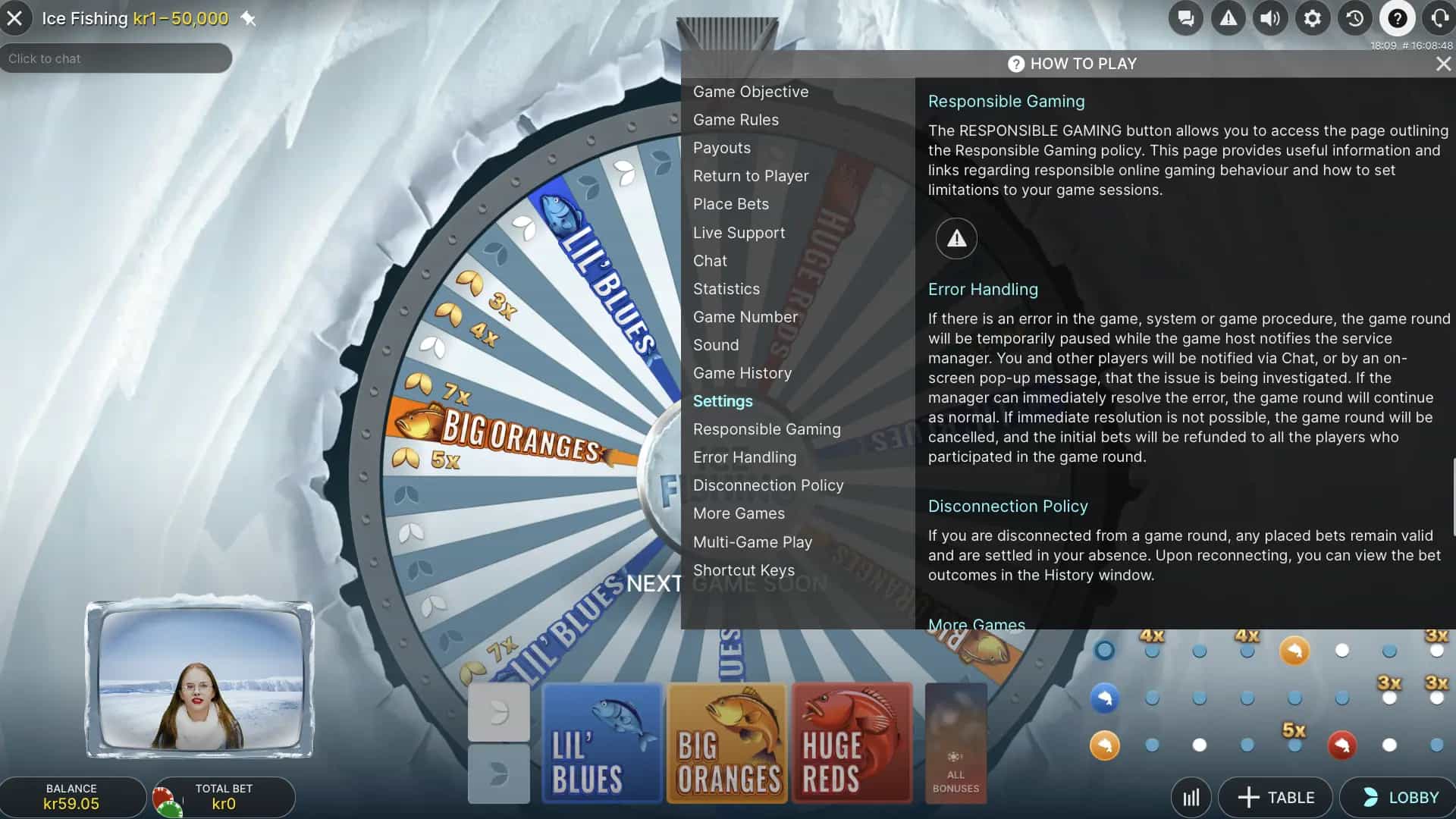
Placing Ice Fishing and Crash games side by side reveals how two formats that both promise fast action and high multipliers can deliver profoundly different experiences. The comparison below highlights the most significant points of divergence that should inform your choice between the two formats.
| Aspect |
Ice Fishing |
Crash Games |
| Core game mechanic |
A 53-segment virtual money wheel spun by a live host, with the outcome determined by where the flapper stops |
A continuously rising multiplier that crashes at a random RNG-determined point, with no physical device involved |
| Player control during the round |
Passive after placing the bet — the player watches the wheel spin and cannot influence the outcome once the round begins |
Active throughout — the player must decide when to cash out, making a real-time decision that directly affects the result |
| Live host presence |
A live human host presents every round from a professional studio, adding commentary, reactions, and theatrical elements to the experience |
No live host in most titles — Cash or Crash by Evolution is the notable exception that blends a host with Crash mechanics |
| Bonus round availability |
Three separate bonus rounds — Lil' Blues (3x–100x), Big Oranges (4x–200x), and Huge Reds (10x–500x) — triggered by specific wheel segments |
No bonus rounds in the traditional sense — every round is a self-contained event with no secondary game layer |
| Maximum win potential |
Up to 5000x the player's stake, achieved through the combination of main game and bonus round multipliers |
Varies by title — Aviator has no fixed cap and multipliers can theoretically reach extreme heights, though crashes at very low values are equally possible |
| Round duration and pace |
Each wheel spin takes several seconds to resolve, with bonus rounds adding additional time when triggered |
Rounds can last from under one second (immediate crash) to over a minute (extended climb), with most resolving in a few seconds |
The table makes clear that these formats serve different player psychologies. Ice Fishing is designed for players who enjoy watching a spectacle unfold and are comfortable with outcomes determined entirely by chance after the bet is placed. Crash games are built for players who want to feel like their decisions matter during the round — the tension of choosing when to cash out creates an emotional experience that is entirely distinct from watching a wheel slow to a stop.
There is also a social dimension worth noting. Ice Fishing's live host creates a shared experience where all viewers are watching the same broadcast and responding to the same outcomes together. The host's reactions to big wins or near-misses create communal moments that enhance the entertainment value. Crash games, by contrast, are primarily individual experiences — even though you can see other players' bets in titles like Aviator, the key moment of decision (when to cash out) is personal and private. Neither approach is superior, but the difference matters for players who value the social aspect of casino gaming.
Where the Two Formats Overlap
Despite their mechanical differences, Ice Fishing and Crash games share enough common ground that many players enjoy both formats within the same gaming session. Recognising these similarities helps explain why fans of one format frequently gravitate toward the other, and why many Australian online casinos feature both types prominently in their lobbies.
- Rapid game cycles that deliver results quickly: Neither format requires lengthy setup, complex animations, or multi-stage processes to reach an outcome. Ice Fishing's wheel spins resolve within seconds, and Crash games can end even faster. This shared pace makes both formats appealing to players who dislike waiting and want continuous action throughout their session, with minimal dead time between the moments that generate excitement.
- Substantial multiplier potential on every round: Both formats offer the realistic possibility of significant multipliers appearing on any given round. Ice Fishing's bonus rounds can deliver up to 500x, while Crash games have no theoretical ceiling in some implementations. The knowledge that any round could produce a large return keeps players engaged across extended sessions in both formats and provides the anticipation that drives repeated play.
- Strong appeal to players seeking alternatives to traditional pokies: The growth of both game shows and Crash games has been driven partly by players looking for something beyond the spin-and-wait cycle of standard slot machines. Both formats offer more visual engagement, more variety in outcomes, and a stronger sense of event around each round compared to the relatively monotonous experience of watching reels stop on symbols. For Australian players in particular, these formats represent the most significant evolution in online casino entertainment in recent years.
- Full mobile device compatibility: Both Ice Fishing and all major Crash games are designed to work seamlessly on smartphones and tablets. Australian players who prefer gaming on mobile devices will find that both formats are fully functional on smaller screens, with interfaces adapted for touch controls and responsive layouts that adjust to both vertical and horizontal orientations without losing any functionality.
Matching the Format to Your Preferences
Choosing between Ice Fishing and Crash games is ultimately a question of what kind of experience you find most engaging. The following table maps common player preferences to the format most likely to satisfy them, providing a practical framework for making your choice.
| What You Value |
Best Format |
Why It Fits |
| Having control over when to secure your winnings |
Crash games |
The cash-out mechanic puts the timing decision entirely in your hands, rewarding players who enjoy active risk management during each round rather than passive observation |
| Watching a live show with a real host and theatrical production |
Ice Fishing |
The live presenter, Arctic studio set, and fishing bonus reveal create an entertainment experience that goes beyond the game mechanics, making each session feel like watching a personalised television show |
| The fastest possible round resolution with minimal waiting |
Crash games |
Crash rounds can resolve in under a second when an early crash occurs, and even extended climbs typically last less time than a full wheel spin cycle with host commentary |
| Variety through multiple bonus mechanics within a single game |
Ice Fishing |
The three-tier bonus system — Lil' Blues, Big Oranges, and Huge Reds — provides distinct experiences within the same game, while Crash games offer the same core mechanic on every round with no bonus layer |
Neither format is objectively superior — they are designed for different moods and different types of engagement. Many Australian players maintain a rotation between both, switching to Crash games when they want the adrenaline of active decision-making and returning to Ice Fishing when they prefer to sit back and enjoy the show. This flexibility is one of the advantages of the modern online casino landscape, where diverse formats coexist and complement each other within the same lobby.
It is also worth considering that your preference may change depending on the context. Late at night when you want a quick, focused gaming session, the stripped-down intensity of a Crash game might suit the moment perfectly. On a weekend afternoon when you have more time and want to be entertained, Ice Fishing's live host and bonus round spectacle might be the better fit. Rather than committing exclusively to one format, many experienced players treat both as tools in their entertainment toolkit, selecting the right one based on their mood and available time.
Betting Approaches Across Both Formats
How you manage your money differs meaningfully between Ice Fishing and Crash games, and understanding these differences can help you approach each format with appropriate expectations and discipline. While neither format offers a guaranteed winning strategy, the way you structure your bets and manage your bankroll can significantly affect the quality and duration of your playing experience.
In Crash games, the dominant strategic consideration is your cash-out timing. Conservative players often set an auto-cashout at a low multiplier — say 1.5x or 2x — aiming to collect small, frequent profits that accumulate over many rounds. This approach sacrifices the thrill of watching the multiplier climb but offers more consistent returns and lower volatility. Aggressive players take the opposite approach, holding out for high multipliers and accepting that many rounds will end in a total loss before the occasional big win compensates. Some platforms allow split bets with different cash-out targets, effectively letting you run both strategies simultaneously within a single round, which is a popular approach among experienced Crash players.
Ice Fishing's betting strategy is fundamentally different because the player has no decisions to make once the wheel is spinning. The strategic element exists entirely in the pre-spin phase, where you choose which segments to bet on and how to distribute your stake. Spreading bets across multiple segments reduces volatility by increasing the chance of hitting something on any given spin, but it also reduces the potential payout from any single outcome. Concentrating your bet on a single segment — particularly a Fish Bonus segment — is higher risk but positions you for maximum return if the bonus triggers. The decision of how to spread or concentrate your bets is the closest thing to active strategy that Ice Fishing offers.
Bankroll management principles apply equally to both formats but manifest differently in practice. In Crash games, the rapid round cycle and the psychological pressure of the rising multiplier can lead to impulsive bet increases after losses, a pattern that depletes bankrolls quickly. In Ice Fishing, the fast wheel spins can produce a similar effect, though the passive nature of the gameplay tends to create less emotional volatility than the active cash-out decisions in Crash games. In both cases, setting a session budget before you start playing and sticking to it regardless of outcomes is the most reliable way to maintain a sustainable relationship with either format.
It is worth emphasising that neither format offers a strategy that guarantees profit. Ice Fishing outcomes are determined by a verified RNG controlling the virtual wheel, and Crash game crash points are similarly generated by audited random number generators. No pattern recognition, betting system, or timing strategy can overcome the mathematical edge built into these games. The strategic elements — segment selection in Ice Fishing, cash-out timing in Crash games — influence your short-term experience and volatility, but they do not alter the fundamental probabilities. Approaching both formats with this understanding allows you to enjoy the entertainment they provide without falling into the trap of believing that a winning system exists.
One practical tip that applies to both formats: track your results over a session rather than focusing on individual rounds. A single spin of the Ice Fishing wheel or a single Crash round tells you very little about the overall experience. It is across dozens or hundreds of rounds that the true character of each format reveals itself — the frequency of bonus triggers in Ice Fishing, the distribution of crash points in Aviator, and the cumulative effect of your chosen bet sizes. Keeping a mental or written note of your session results helps you develop realistic expectations and avoid the common mistake of letting a single big win or loss distort your perception of the game's overall rhythm.